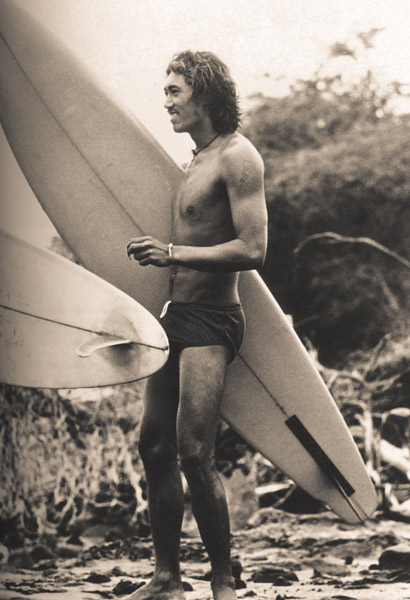
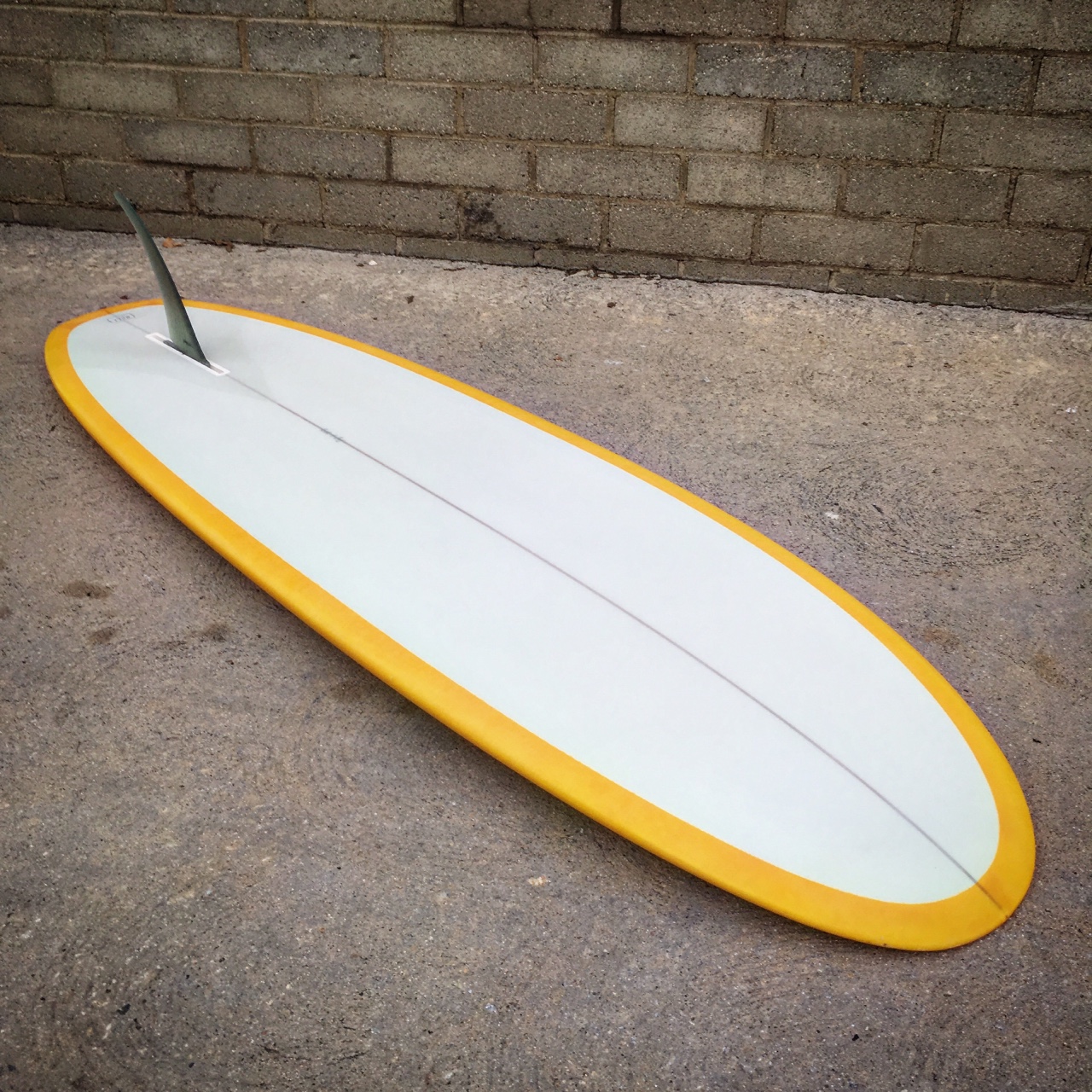
The winter of 1969 was the last gasp of the first generation, displacement hull mini-gun on the North Shore.
As you can see in the top photo, the tails had already transitioned to dropped rails, with mild belly and turn-up remaining in the nose area. The red board Jock Sutherland was riding that year was a Brewer. (Charlie Quesnel is on the left. Not sure who's in the middle.)
Some footage of that board starts at the 7:25 mark...
The hulled mini-guns were still the norm during the fall of 1969...then Joey Cabell turned up at the Duke Invitational in December with a true, nose-to-tail lowrailer and won the contest (whatever that's worth). For better or worse, all hell broke loose in the surfboard design world in the following weeks, months, and years.
Cabell's "breakthrough" down railed gun was foreshadowed by the edge-boards of Bob Smith, Bunker Spreckels, et al. They're documented in
Cher Pendarvis' piece in Surfer's Journal 26/1.
--------------------------------------------------------------------------------------
A sample from Cher's article...
Edge Boards and The Mysterious Mr. X
Edge boards were ridden for just a few years, primarily on Oahu’s
North Shore, in Kauai, and in San Diego at Sunset Cliffs, by a core
group of outstanding surfers. The design was originally made for steep,
powerful waves and was first ridden at Pipeline and Pipeline Rights in
the fall of 1968. The original edge board crew contained surfers and
designers spread across Hawaii and California, including “Mr. X,” Vinny
Bryan, Rick and Todd Value, Dana Nicely, Eric Gross, Robbie Cushnie, and
Bunker Spreckels.
The design was the first true shortboard. Through rail modifications
and bottom contours, the craft’s proponents pioneered “on top of the
water” surfboard design. They also made breakthroughs with the down rail
concept that over the years has led to the progressive tucked under
rails of today. Before edge boards, surfboard rails were relatively
soft, even in the tail. Edge boards, on the other hand, had hard down
rails and mostly flat bottoms. They were ridden with a variety of fins,
including small keel fins, reverse keels, vertical fins, finger fins,
and occasionally were surfed finless.
While the design sprang from many minds, “Mr. X” conceived the first
edge boards. His desire to fly fast over the water drew him to explore
“low drag” and in doing so he designed thick, down railed boards with
flat planing surfaces and razor sharp edges from nose to tail. “He
experimented with different rockers, templates, and bottoms,” says Ben
Ferris, who was part of the Cliffs and Kauai edge board crews. “He had
designed boats and understood water flow. The whole shortboard evolution
was helped by the edge boards—these short, thick, down rail boards
helped everything go shorter.”
“Of all of the people I’ve spoken to about edge boards,” confirms Nat
Young, who was on the frontlines of the Shortboard Revolution, “Mr. X
is known to be the father of the edge board. Yet no one has ever heard
of him.”
A.K.A. Bob Smith, Mr. X was born Robert Imhoff in 1945. He grew up in
Los Angeles and continues to use “Bob Smith” as his nom de guerre
today, primarily because this was the name he went by during his early
North Shore surfing adventures. His interest in wave riding began in
1960 in the South Bay. By the summer of 1961, he was embarking on quests
as far south as Ensenada, and as far north as San Francisco, camping in
his panel truck. He was always interested in how things worked. The
very first board he made was an experimental finless with a deep concave
than ran one quarter the length of the board from the tail. “I built
stuff,” he says, “fixed most everything, and tried to improve things. I
consider myself to primarily be an inventor and that’s how I approach
any area. I ask, how can I understand this, and what can I do to improve
it? Currently, I’ve been developing an exotic high-speed sailboat and
have one patent on it so far. I always fixed my surfboards and started
making my own in about 1965.”
In the summer of 1967, Smith decided to “drop out” and go to Hawaii.
This was when he changed his name to Robert Smith, commenting, “How ya
gonna drop out if you take it all with you?” He took his surfboard and
suitcase to LAX and jumped on a one-way flight. Pipeline was high on his
list of places to explore.
He made his first North Shore board in the winter of 1967. It was a
very thin, 9’6″ semi-gun with down rails. Paddling it was challenging
because it sat submerged in the water like a modern shortboard. “I broke
it twice at Pipe,” he says, “but did get some good rides on it.”
Australian surfer and design pioneer Bob McTavish was at Pipe in 1967
with Dick Brewer and Mike Hynson and observed Mr. X flying on his 9’6″.
“We saw the first down rail board, produced by an unknown guy,”
recalled McTavish in
Tracks magazine in 1980. “And do you know
how the three leaders in design from California, Hawaii, and Australia
at that time reacted? We laughed! Then the guy proceeded to paddle out
at Pipeline on his knife-edged down railer and to our shock and
amazement, it didn’t dig in. It just flew across the wall.”
----------------------------------------------------------------------------------