Transition Era Fin Box Flow Chart


The fin box was an essential ingredient during the shortboard revolution, especially when it came to displacement hull surfboards beyond 1970.

Let's take a thumbnail look at the progression...

George Downing developed what's generally considered the first fin box, C 1951...


This is a removable teak fin made for one of Downing's customers a few years later...


 Hobie built a Makaha gun with a fin box in 1955...


There were several crude removable fin systems used in the early-to-mid 60s, delineated here.

Tom Morey began to penetrate the U.S. surf industry around 1964 with his semi-permanent fin system. The fins were press fit into the box, then secured with resin.

This is a molded plastic Yater design from Morey Skeg Works...


 Here's a Greenough Stage 2 from the Skeg Works...


The Wonderbolt was next for Morey. It was similar to the Skeg Works resin-bond approach, but had a bolt in the back of the fin that would "back out" and secure the fin in the box. Fins could be removed and/or replaced in a matter of seconds. More fin designs were offered, like this Weber Hatchet...
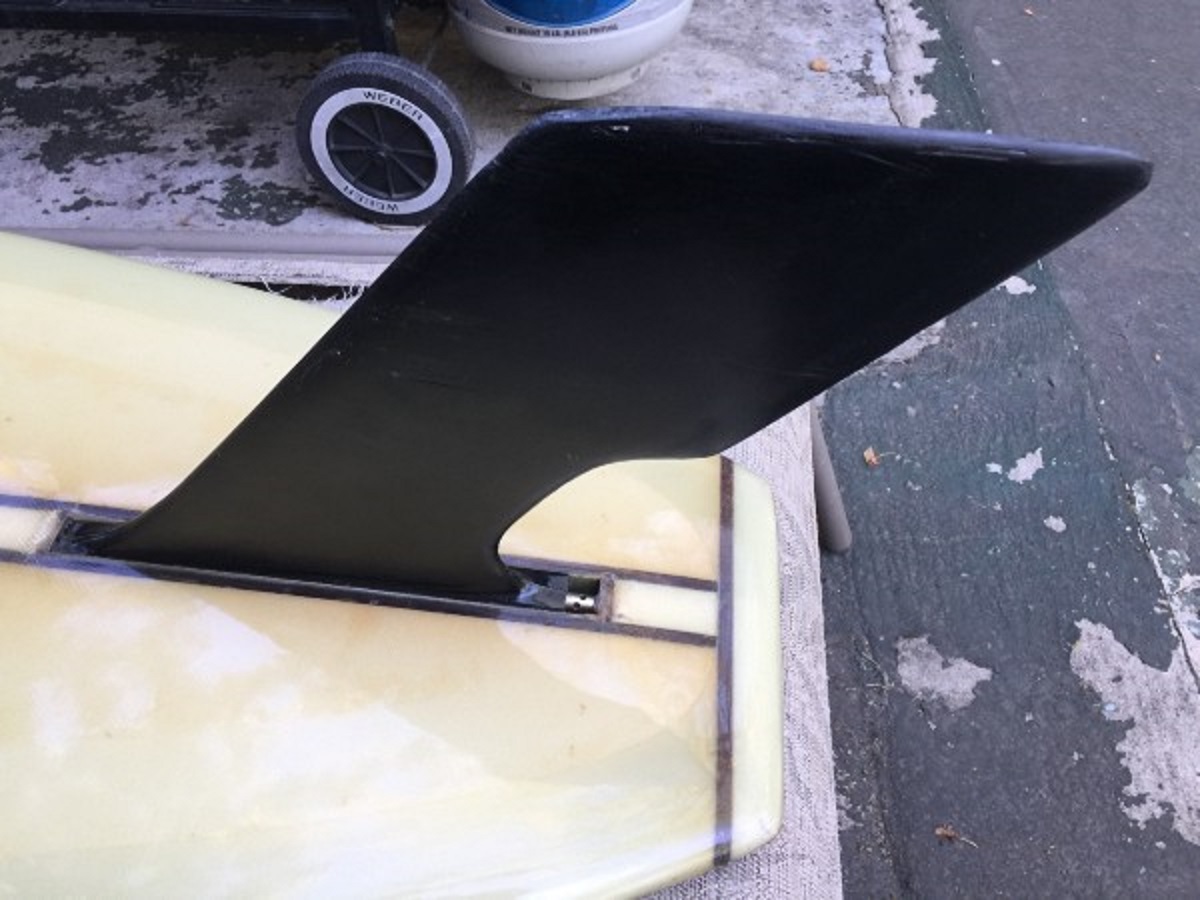

...or this Greenough Stage 3...


Greg Noll used a similar system on their own boards...


A couple of years later, Tom Morey generated mainstream acceptance of removable fins with his WAVE Set box. It featured a number of fin designs from established builders like Yater, Harbour, G&S, Bing, Weber, and O'Neill...

Weber Hatchet Fin
O'Neill Raked Kelp Fin

G&S/Skip Frye High Drift Mini Fin

...not to mention the Stage 3 power surfing fin from indie designer George Greenough...


Down in San Diego, Bill Bahne answered Morey's Ventura-based effort with the Fins Unlimited system in 1968. It was smaller and lighter than the WAVE Set system, but not as well bonded into the board...


The WAVE box had a wide lip that was glassed over, making it much more durable...


Bahne also offered fewer fin designs to choose from...


Linda Benson with a board using the early Fins Unlimited system.

Like Greg Noll, Hobie went with an in-house unit from the end of the longboard era through the transition era. It also utilized a single through-bolt from the deck into the fin.


All these units worked fairly well in small surf, but the placement of the fin was determined by the builder. There was no chance a surfer could alter the location of the box once it was installed.

The next step forward was a moveable fin system in 1969.

In deference to his existing customer base, Morey utilized a sub-unit that would bolt into the original WAVE Set boxes.


The newly minted Greenough Stage 4 fin, with its narrow base, was well suited to the concept. There was plenty of room for back and forth adjustment...


Taking a different approach, Fins Unlimited introduced an entirely new adjustable unit, the Vari-Set. There were only two fins available to fit the box, a short pivot fin and a longer power surfing fin...


Like it's FU predecessor, the Vari-Set was flimsy as hell, and prone to cracking around the corners...


Hansen developed their system that utilized a single anchor bolt, a long box, and a fin with multiple bolt receptors, allowing for movement...


Bing also made their own fin box called "Guidance System." Boltless and adjustable, the fin snapped into the box without screws to hold it in place. Since plastic is so malleable, the fin would work loose over time, so it was short lived...


The chaos finally abated in 1970, when Fins Unlimited introduced a fin box that addressed most of the issues presented by the older units...


The new FU box was strong, the fin was both moveable and firmly anchored, and surfers weren't limited to the weak plastic fins offered by box manufacturer...


Individually made fiberglass fins became the norm, and shortboard surfing took a quantum leap forward...
 

Since its inception, the Fins Unlimited box was a key factor in the advancement of displacement hulls. It remains the single fin standard today...


Imagine how many waves have been traversed with boards utilizing the Fins Unlimited fin box over the past 5 decades...millions!
 

Corky Carroll: The Transition Era

Corky Carroll has been pretty much lost in any discussion about the transition era...especially among displacement hull aficionados. 

Part of it was because he was overtly commercial in an era when it was considered declasse'...


Part of it was because his early shortboard surfing held on to the longboard ethos...meaning he focused on sweeping pivot turns off the tailblock, walking the nose, etc etc.

 
And part of it was because his Hobie Mini Model didn't truly break new ground, being a shortened longboard for all intents and purposes.


That said, he was the earliest Californian to publicly embrace shorter boards. The first Corky Carroll Mini Models were out in 1967...and just co-opting the word "Mini" for surfing was a coup, given the popular mainstream use of the word at the time.

The early Minis were mostly in the 9 foot range -- presumably drawing off of Nat Young's 9'4'' World Contest board from the previous summer. Not a radical change, but a step forward.

The 'Super Minis' that followed dropped down into the 7 foot range, but they weren't especially good boards. (Hobie head shaper Terry Martin said Corky was the only surfer who could make them work.)


Most of the media coverage of Carroll in the late 60's was in and around the small wave California contest scene...but as you can see from these two shots, he rode the shit out of transition era boards when facing a 'real' wave.


What's gives Corky Carroll's legacy weight is the surf stoke he carried from of his career as a professional surfer into his "elder spokesman" phase...which is now entering it's 5th decade! First and foremost he was a surfer, and he's remained in that mindset through all the subsequent years and eras.

His regular articles in the OC Register are grounded in a waterman's perspective, and worth a read even if you don't relate to his talking points.

Here's the evolution of the Hobie Corky Carroll Models...from conventional board, to stringerless longboard, to early shortboard, to super shortboard. Roughly 1965 through 1968.


Stringerless Sunday, Wednesday Followup


Prior to his stringerless period, Midget went through a 3 stringer phase himself. (Although technically, this was a 4 strip board.)

He won the first World Contest at Manly Beach in 1964 on that same board...


...and his company's skateboard also had three stringers!


A year later, Midget went stringerless on his surfboards. Not sure about his skateboards!

Loading Up The Inside Rail With A Semi-Parallel, 45 Degree Stance: A Visual Tutorial


Stringerless Sunday, Monday Followup

After the previous post, how does this three stringered Phil Edwards Model look to you now? To me, it seems like there's a picnic table inside the board!

When the Phil Model hit the scene, the three stringer 'look' took on a life of it's own. It became a symbol of style and elegance.  Edwards later said that the reason he used three stringers was to prevent his boards from warping...a common occurrence during the longboard era.

Imperfect stringer cuts (on single strip boards) often caused twist. Fiberglass that didn't come off the roll with the weave at a perfect 90 degree bias also led to warpage. If you sight down the deck of a 60's era longboard, it's probably twisted. But not if it's one of Phil's. They're straight and true 95% of the time. That's because the three stringer arrangement provided enough structure to keep them from warping.

As is the case with any field of design, there's usually a good reason for decisions that might seem irrational. The three stringer setup, while stiff and heavy, was grounded in practical need...to stop boards from twisting.

BTW, the serial number on the board pictured above was #103. Meaning, it was most likely the 4th Phil Edwards model ever built.

Stringerless Sunday

 
Several years before the shortboard revolution, Midget Farrelly began making stringerless boards in his factory in Australia. To be sure, he wasn't the first to go stringerless, but he was the first highly visible, world class surfer to do so.

Farrelly's stringerless boards were noticeably lighter and more flexible. The result was a lively ride that foreshadowed the downsizing that occurred a few years later.

It was a real improvement, and a number of manufacturers in Australia and the US developed stringerless boards for their model line prior to the shortboard revolution.

 Weber

 Harbour

 Hobie

 
Gordon Woods
 Gordon and Smith, USA
Harbour

Here's a shot of the best contest surfers in Australia at Bells, early in 1967. Midget is on the far right, with a stringerless. Nat Young, second from the right, is with his followup board to 'Magic Sam,' which was lost in California some months earlier...


You can see a Greenough fin on Nat's longer, stringered board, while Midget's stringerless sports a less sophisticated contest/pivot fin. They were each heading the right direction, but neither had it all together yet.  

Taken to the extreme, stringerless boards during the end of the longboard era approached Greenough's level of flex...